The consultant
Decides which tables, fields and CDS views answer the business question — weeks of workshops and tribal knowledge.
A business question goes in; a governed, analytics-ready warehouse comes out — with no consultant, no ABAP team and no data engineer in the loop. SCIKIQ's LLM-native pipeline scopes the right SAP tables, extracts them with business logic intact and builds the warehouse, collapsing three scarce specialists and three separate tools into one automated loop.
A single business question runs through three specialists in sequence — months before one dashboard exists. And they are exactly the roles the market can no longer staff at pace.
Decides which tables, fields and CDS views answer the business question — weeks of workshops and tribal knowledge.
Hand-writes extraction logic, table by table, keeping SAP business logic intact all the way through.
Designs and builds the target warehouse: schema, DDL, transforms, delta merge and history.
Slow, expensive and bookable only at inflating rates — a multi-month project before a single dashboard exists.
Every SAP estate must move its data on a hard clock — and as the 2027 deadline nears, the specialists who do it are booked out and charging more. The buyer's pain is a supply problem, and automation solves it directly.
SAP ends mainstream maintenance for ECC 6.0 on 31 Dec 2027, with paid support only to 2030. Every estate must move its data — on a hard clock.
92% cite missing S/4HANA skills as the blocker, and experienced teams are booked out. The people to do this the old way simply are not there.
As the deadline nears, consultant day-rates are inflating 10–50%. Waiting makes the human path both slower and more expensive.
ERP programmes run into the hundreds of millions, yet only about one in five capture half the projected value (McKinsey). The bottleneck is the data.
The prize: what a unified SAP data foundation unlocks
When enterprises consolidate their data and put it to work, the outcomes are step-change, not incremental — illustrative results from large data-and-ERP transformations.
One platform. A business question goes in; a governed warehouse comes out. Three human roles and three separate tools collapse into a single automated, LLM-native loop — and the layer nobody else automates is the first one.
Reads the business question and selects the SAP tables, fields and views — the judgement step no competitor automates.
Extracts the data with SAP business logic intact — live at SCIKIQ today, no ABAP hand-coding.
Generates the schema, DDL, transforms, delta merge and history on your target warehouse.
The warehouse is instantly useful — dashboards, KPIs, lineage and controls, from day one.
Under the hood
The inputs are your business question plus SAP's own metadata — the data dictionary, CDS views and real usage statistics (ST03N).
RAG over the SAP catalogue maps the question to candidate tables, fields and joins, then ranks them by relevance and actual usage.
The ABAP automation pulls the selected objects via ODP, CDS and tables — keeping SAP business logic intact.
An LLM proposes a Kimball dimensional model, then generates the DDL, transforms and delta-merge on the target.
Trust is built in. Nothing lands unaudited: a human signs off the scoped source-map, every field carries full lineage back to SAP, and each mapping ships with a confidence score. SCIKIQ starts as an expert assistant and earns its autonomy.
SCIKIQ Connect ships with a rich library of extraction and transformation routines that move SAP data from the application, database or API layer straight into a governed cloud data lake — overlaid with cataloguing, quality and lineage from the SCIKIQ Control module.
Business and data teams build extractions in a visual designer — no ABAP hires, no bespoke connectors to maintain.
Minimal-to-zero impact on the SAP source, with automated data reconciliation you can trust.
Every dataset lands catalogued, quality-checked and lineage-tracked — the governed foundation gen AI and agentic AI actually need.
Collapse the data-to-action timeframe from months and years to days, and free your team for real analysis.

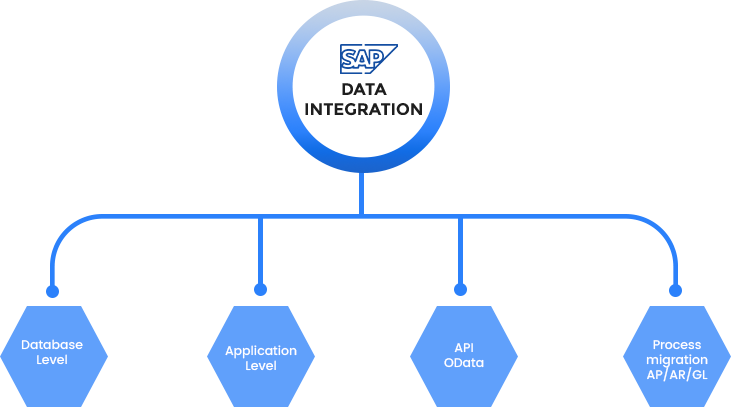
Reach SAP at whatever level fits the job — raw database writes, application functions, OData services or whole business processes — all through one no-code engine, full or delta.
An extraction framework reads data as it is written to the SAP database, transforms it and writes to Snowflake, Vertica and more.
Remote Function Call libraries connect natively to function modules, views, tables, queries, BAPIs and TCODEs.
Browse OData services via the SAP Catalog, retrieve entity metadata and design an extraction job in minutes.
Pick a business process and let SCIKIQ pull data from every related table for consumption and dashboarding.
Full coverage, every object type
Full and delta extraction across every major SAP platform — down to the specific tables, extractors, views and functions your reports depend on.
S/4HANA, BW on HANA and BW/4HANA, and ECC on HANA — each with full and delta modes.
Transparent and clustered tables such as BSEG — full loads or delta by timestamp or incremental column.
Standard and custom extractors and ABAP CDS views like I_SALESORDERITEMCUBE, full or delta.
Call TCODEs (VA03) and BAPIs (BAPI_MATERIAL_GET_DETAIL) directly, with guided parameters.
Full backfill, daily change capture, live streams or a whole business process. Each is a no-code, schedulable, fault-tolerant job. Explore each approach below.
Backfill the full history from SAP into an MPP target — Vertica, Snowflake, BigQuery and more.
Profile the data, metadata and DQ rules up front, so nothing lands in the lake unchecked.
Assign infrastructure declaratively; PODs spin up on demand to run the migration in parallel.
Select the tables and objects to migrate and create the job — no scripting required.
Fault-tolerant jobs restart from the last checkpoint if anything fails mid-load.

Keep the lake current by pulling only what changed — on a schedule, with no full reloads.
Create delta jobs that capture changes by business date, timestamp or incremental column.
For BW ADSOs, fetch delta requests by Request ID so nothing is missed or double-counted.
Schedule delta jobs with the SCIKIQ scheduler — batch or micro-batch, hands-off.
Choose a delta or truncate-and-load strategy per pipeline to match the object.

Stream SAP changes as they happen with Kafka source and sink connectors, or log-based CDC.
Create SAP HANA source and sink connectors to publish and consume change events.
Capture changes via Debezium log mining — even when a direct DB connection or open API is not allowed.
Set up and test the source and sink configuration before a single event flows.
Publish or consume Kafka topics to power real-time use cases downstream.

A business-first path: pick a process and let SCIKIQ pull every related table — no need to know the technical landscape.
Choose AR, AP, GL, P2P and more — SCIKIQ knows the tables and relationships behind each.
Tables and objects are pre-selected; add custom tables to match your SAP implementation.
Functional experts have mapped the key attributes and KPIs for each process, ready to consume.
Select the SAP source and the data-lake target, then migrate — entirely in the UI.

This is what sets process migration apart: our functional experts have already mapped the key attributes and KPIs for core finance processes. A process owner picks AP, AR, GL or P2P — and gets analysis-ready metrics, without ever touching a table name.
Every metric a payables team asks for — parked and blocked invoices, aging, days payable and processing cost — captured the moment you pick the process.
See collections, aging and revenue leakage at a glance — days receivable, disputed invoices, days beyond term and more, straight from SAP.
SCIKIQ pulls GL data — including clustered tables such as BSEG — so finance can build trial balances, account analysis and reporting on governed data.
Balances and movements by GL account, cost centre and period, ready for reporting.
Line-item journal detail for audit, reconciliation and anomaly detection.
Period-over-period trial balance built on trusted, lineage-tracked SAP data.
One-time history plus daily deltas keep financial reporting current automatically.
SCIKIQ pulls P2P data — including material-document tables such as MKPF — for end-to-end procurement visibility from PO to payment.
From requisition to purchase order to receipt — where procurement slows down.
Material documents and GRN detail for inventory and three-way-match analysis.
PO, receipt and invoice reconciled to surface exceptions and maverick spend.
On-time delivery, price variance and spend concentration by supplier.
Infrastructure on demand, full fault tolerance and elastic scale — with the flexibility to fit however your data needs to flow.
PODs spin up automatically per job or schedule — no manual provisioning, no idle cost.
State is tracked at every level; failed tasks restart or resume from the current checkpoint.
Micro-services scale horizontally and vertically — scale one service or the whole platform.
Elastic and APM integrated for robust logging and application-performance monitoring.
Six transfer topologies, one platform
Acquire once and publish many, consolidate into a warehouse, cascade to data products, virtualise without moving data, or run bi- and uni-directional flows — plus a lightweight API Hub with a drag-and-drop flow designer to connect anything, anywhere.

The same SAP estate, delivered the old way and the SCIKIQ way. Roughly 10x faster, at a fraction of the cost — and the scarcity risk disappears.
Proven at scale
And it scales linearly: a real benchmark over SAP OData — the same 40.9-million-record extract on 1×4GB PODs at increasing parallelism. PODs spin up on demand, so you only pay while the job runs.
Ready to set your SAP data free?
Bring your toughest SAP extraction — we will show you it running, no pitch, no form maze.
Yes. SCIKIQ provides no-code, non-invasive SAP extraction — no ABAP coding, specialist consultants or data-engineering pipelines required.
SAP ECC mainstream maintenance ends in 2027, and the specialists needed to extract SAP data are scarce and expensive. SCIKIQ removes that dependency so you can capture SAP value sooner.